
Ferris Wheel Bayside: Panoramic Seaside Views & LED Show
Bayside Icons: The 89M Steel Cable Ferris Wheel With Arms, Up Close
Waterfront developers keep asking for a true anchor attraction — and honestly, a ferris wheel bayside does the job better than almost anything else. The 89M Steel Cable Ferris Wheel With Arms, built in Hebei Province (No.2969 Xiangdu South Road, Xiangdu District, Xingtai City), is one of those big, reliable crowd-magnets that reshapes a skyline and, quite often, the local economy around it.
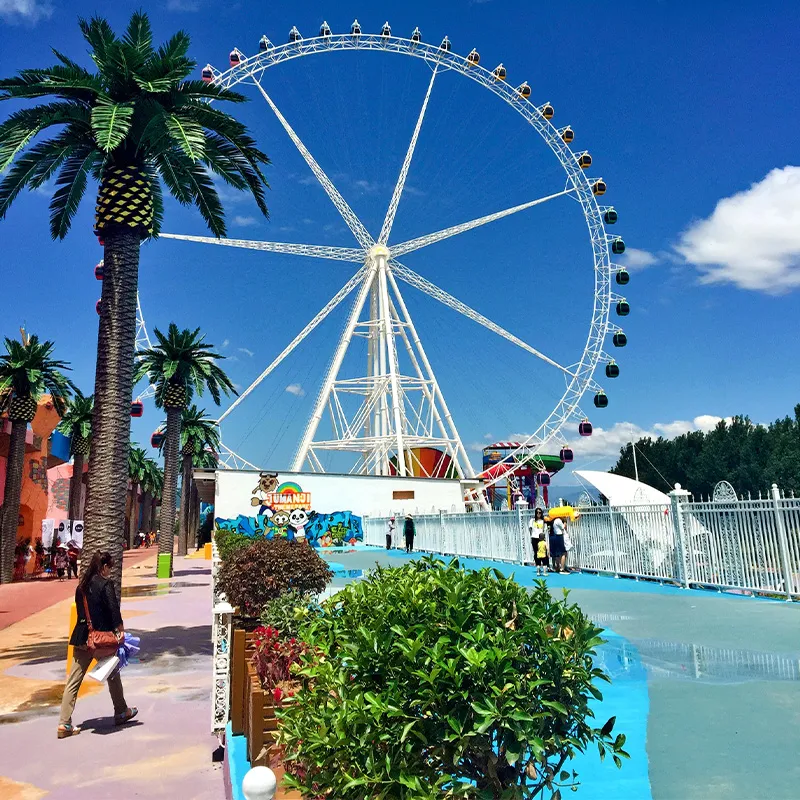
Industry snapshot: why waterfront wheels keep winning
Trends I keep seeing: climate-controlled cabins, LED façade shows, and quieter drives. Cities want placemaking with a measurable return — longer dwell times, retail uplift, and prime sponsorship inventory. To be honest, the “Instagram factor” is real; the right ferris wheel bayside turns a boardwalk into a destination. Sustainability’s creeping up too: low-noise motors, smart power distribution, and corrosion-proofing for salt air.
Product specs at a glance
| Model | 89M Steel Cable Ferris Wheel With Arms (Class A) |
| Total height | 89 m; Rotating diameter: 85 m; Operating height: 87 m |
| Gondolas / capacity | 49 cabins × 6 persons = 294 riders/cycle (real-world throughput ≈700–1,200 pph depending on cycle) |
| Speed | 18 mpr (vendor spec); drive power 37 kW |
| Power | A/C power 98 kW (49×2 kW); installed capacity 169 kVA; supply 3N+PE 380/220V 50Hz |
| Footprint | Projection: 85×45 m; Base: 39×45 m |
| Design service life | 20 years (fixed installation) |
| Equipment type | Ferris wheel with spindle; Viewing vehicle |
Build and verification (short version)
Materials: high-strength structural steel (often Q345B/S355), CNC-cut arms, cable spokes; hot-dip galvanizing to ≈85 μm per ISO 1461; marine-grade coatings for bayside installations. Methods: robotic welding where critical, torque-controlled assembly, sealed bearings, PLC-based control with redundant safety relays. Testing: NDT on welds (UT/MT), bolt preload verification, overspeed and e-stop tests, 110–125% static load test, dynamic load endurance, insulation resistance, and full FAT/SAT to EN 13814/ASTM F2291/GB 8408. Service: planned inspections at 250/500/1,000 h; annual major check.
Where it fits
Bayside promenades, harbor redevelopments, mixed-use retail, resort piers, and city parks that need a skyline-defining profile. Advantages include all-weather operation (A/C cabins), strong sponsorship visibility, and surprisingly modest ground load relative to visual impact. Many customers say the queue itself becomes a social space.
Vendor landscape (practical comparison)
| Vendor | Standards / Class | Customization | Lead time | Warranty | After-sales |
|---|---|---|---|---|---|
| ZP Roller Coaster (this model) | Class A; EN 13814 / ASTM F2291 / GB 8408 aligned | High: cabins, lighting, branding, HVAC | ≈6–10 months | 12–24 months typical | Global partners; remote diagnostics |
| Global Rides Co. | EN/ASTM compliance options | Medium | ≈8–12 months | 12 months | Regional hubs |
| Skyline Wheels Ltd. | EN 13814 focus | Medium–High | ≈10–14 months | 12–18 months | Europe/APAC |
Notes: indicative, real-world use may vary by project scope and certification path.
Customization that matters
Options include panoramic or VIP cabins, double-glazing with low-E glass, integrated media/PA, RGBW pixel lighting, branded façades, corrosion packages for marine air, and queue architecture. For a ferris wheel bayside, I’d always spec enhanced sealing, stainless fasteners, and an LED show that plays nicely with the waterfront skyline.
Real-world deployments (anonymized)
• Coastal promenade, Middle East: operators reported ≈15% uplift in F&B sales within three months; guests praised cabin A/C in humid evenings. • Southeast Asia mall pier: branding on two VIP cabins sold out pre-opening; maintenance team liked the remote fault logs. It seems the quieter drive cut complaints from nearby residences.
Compliance, test data, and paperwork
Manufactured under ISO 9001:2015 at the Hebei facility; conformity engineering aligned to EN 13814, ASTM F2291, and GB 8408. Typical FAT results (representative): 110–125% static load pass; e-stop stopping distance within calculated envelope; insulation ≥1 MΩ; base-borne vibration ≤3.5 mm/s; operational noise ≈60–65 dB(A) at ground. Energy draw lands around 110–150 kWh/h with full A/C, depending on cycle profile. To be honest, waterfront wind policy is key: plan operational and survival wind thresholds in the manual and SCADA.
If you’re weighing a ferris wheel bayside, factor in sponsorship, event lighting, and maintenance access. The engineering is solid; the real magic is how it stitches a waterfront together.
Authoritative standards and references
- EN 13814:2019 – Safety of amusement rides and amusement devices.
- ASTM F2291-20 – Standard Practice for Design of Amusement Rides and Devices.
- GB 8408-2018 – Safety Code of Amusement Rides (China).
- ISO 1461:2022 – Hot dip galvanized coatings on fabricated iron and steel articles.
-
Ethiopian governmentApr.12,2024
-
On March 20-22Apr.12,2024
-
Comprehensive Guide to Choosing the Perfect sightseeing wheelApr.16,2026
-
Guide to Choosing a Roller Coaster and Ferris Wheel for Your ParkApr.09,2026
-
Find Your Perfect Portable Ferris Wheel for Sale and Elevate EntertainmentApr.07,2026
-
The Captivating World of Portable Ferris Wheels and Event EntertainmentApr.04,2026