
Roller Coaster Classifications | Types & Manufacturers
A Pragmatic Guide to roller coaster classifications (with real-world notes)
If you ask five park operators how they classify coasters, you’ll hear six answers. To be honest, the industry runs on practical buckets more than academic taxonomy. Still, certain families repeat: wooden vs. steel; sit-down, floorless, inverted, wing, spinning, flying, stand-up, and the wild-card 4D. Then there’s the ride dynamic: chain-lift vs. launch; family, thrill, or extreme; permanent vs. portable; and the increasingly common “hybrid” that blends wooden structure with steel track. In practice, planners start with footprint and throughput, then match a profile that fits local demographics.
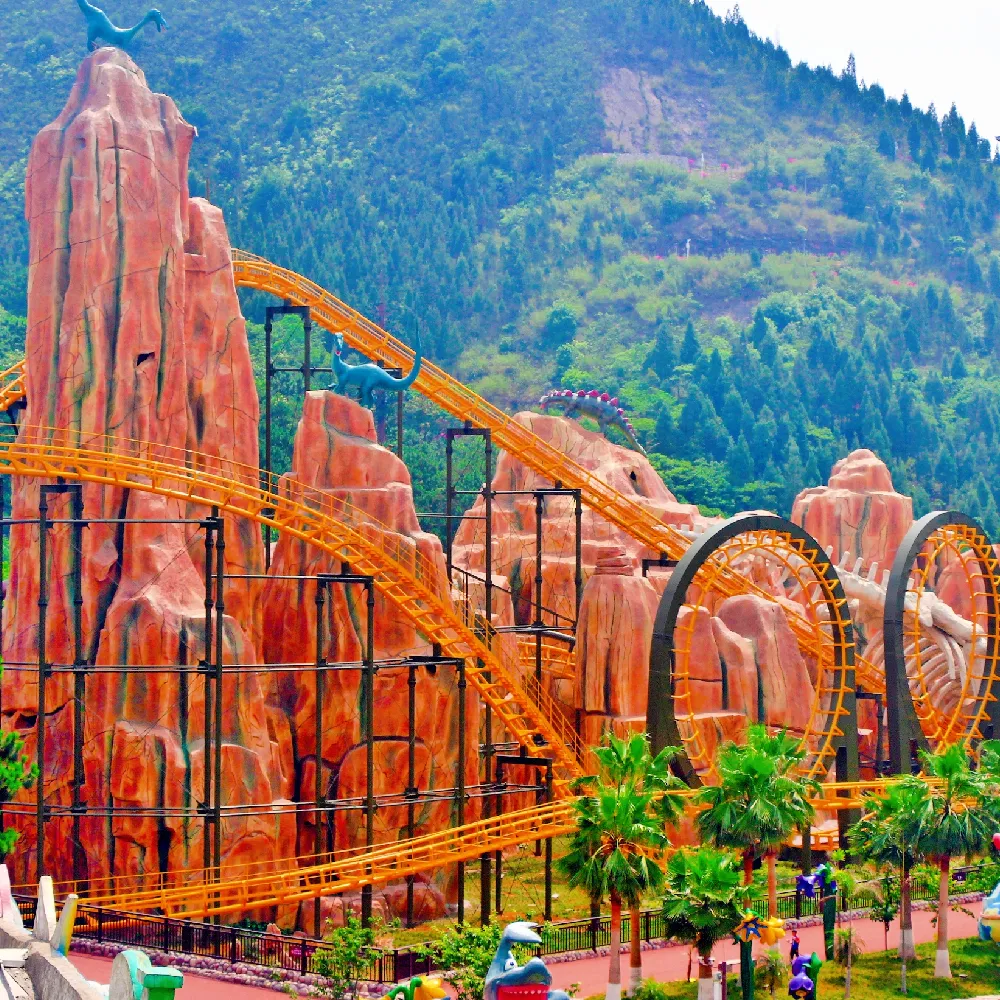
Where the Four-Loop Model Sits in the Landscape
Looping coasters are classic “steel sit-down, inversion-forward” attractions. The Four Loops Roller Coaster is a compact thrill category piece—ideal for parks that want a signature silhouette without a mega footprint. Actually, the four inversions and ≈100s cycle time give it a crowd-pleasing cadence for mid-sized venues.
Product Snapshot: Four Loops Roller Coaster
| Track Length | 480 m | Origin | No.2969 Xiangdu South Road, Xiangdu District, Xingtai City, Hebei Province |
| Highest Point | 25.2 m | Cabins / Passengers | 4 cabins / 16 persons total |
| Top Speed | ≈69 km/h (real-world may vary) | Power | 90 kW (installed) |
| Area | 90 m × 40 m | Run Time | ≈100 s per cycle |
How Builders Classify (and Build) the Hardware
Materials: low-alloy structural steels for supports, tubular steel track, hot-dip galvanized or epoxy/polyurethane coated; trains use welded steel chassis with FRP body shells and polyurethane wheels. Methods: finite element analysis, dynamic envelope modeling, and progressive brake-zone validation. Testing: NDT on critical welds (UT/MT), bolt pre-load verification, proof-load on restraints, and functional safety checks (SIL-aligned logic where applicable). Typical service life: ≈20–30 years with mid-life overhauls at 8–12 years.
Standards that commonly guide design and inspection include EN 13814 / ISO 17842 and ASTM F2291/F1193. Many customers say they like seeing fatigue test documentation—fair—because it’s a useful proxy for lifecycle cost.
Application Scenarios
- Regional parks needing a headliner within a tight 90×40 m pad.
- Resort add-ons seeking a high-visibility skyline element.
- Seasonal destinations that prioritize reliable throughput over extreme height.
Customization Options (typical requests)
- Train theming, onboard audio wiring, and LED accent packages.
- Restraint ergonomics tuned for wider rider demographics.
- Queue integration, shade structures, and evacuation walkways per local code.
Vendor Landscape (what buyers quietly compare)
| Vendor | Strengths | Notes |
|---|---|---|
| ZP Roller Coaster (Four Loops) | Compact footprint, clear spec transparency, pragmatic O&M guidance | Origin: Xingtai, Hebei; supports EN/ASTM-aligned documentation |
| Vendor A (global) | Broad portfolio, extensive reference parks | Lead times can be longer; pricing premium typical |
| Vendor B (regional) | Aggressive pricing, flexible theming | Specs vary; verify test data and inspections |
Test Data & Safety Envelope
Typical acceptance targets: peak vertical G around +4 to +4.5G (brief), lateral G with comfort shaping, wheel-load margins validated under worst-case trains, and brake-heat monitoring. Fatigue design often references 106–107 cycles for critical nodes. Real-world use may vary with climate and maintenance discipline.
A Quick Case
One mid-size park in a humid coastal climate installed a four-loop layout to replace an aging shuttle coaster. The team reported smoother daily start-ups, fewer night maintenance callouts, and a noticeable lift in merch per cap—brandable loops help. Guests, anecdotally, mentioned “not too scary, but still crazy,” which is exactly where this model wants to sit in the roller coaster classifications matrix.
Why Classification Still Matters
Procurement, marketing, and ops all speak different dialects. A shared frame—like roller coaster classifications by train type, inversion count, or rider profile—keeps the conversation honest. It also aligns with certification pathways and inspection regimes.
Citations
- ASTM F2291 – Standard Practice for Design of Amusement Rides and Devices.
- ASTM F1193 – Standard Practice for Quality, Manufacture, and Construction of Amusement Rides and Devices.
- EN 13814:2019 – Safety of amusement rides and amusement devices (Parts 1–3).
- ISO 17842 (Parts 1–3) – Safety of amusement rides and amusement devices (global adaptation).
-
Ethiopian governmentApr.12,2024
-
On March 20-22Apr.12,2024
-
Comprehensive Guide to Choosing the Perfect sightseeing wheelApr.16,2026
-
Guide to Choosing a Roller Coaster and Ferris Wheel for Your ParkApr.09,2026
-
Find Your Perfect Portable Ferris Wheel for Sale and Elevate EntertainmentApr.07,2026
-
The Captivating World of Portable Ferris Wheels and Event EntertainmentApr.04,2026