
Large Amusement Equipment: Safe, Durable, Custom Turnkey
W-type Dream Flying Car (Single): A Field Note From the Midway
If you're scouting for Large Amusement Equipment that balances thrill with throughput and a sensible footprint, this model has been popping up in my inbox all year. To be honest, I didn’t expect much the first time I rode it—then the lateral swing on the W-profile surprised me. In a good way.
Built in Hebei Province (No.2969 Xiangdu South Road, Xiangdu District, Xingtai City), the W-type Dream Flying Car (Single) is the kind of mid-tier crowd-pleaser parks use to freshen a zone without the capex shock of a hypercoaster. Industry friends call it a “family thrill bridge” ride. I guess that label sticks.
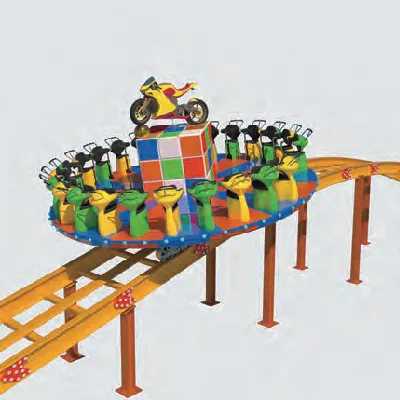
Why this Large Amusement Equipment is trending
- Compact site fit: 90 m × 12 m strip—perfect for narrow pads, re-themes, or waterfront edges.
- Throughput sweet spot: ≈480 riders/hour with a single 24-seat cabin; operating teams say queue times feel “fair”.
- Energy profile: 112 kVA total power, which—considering the motion envelope—operators say is “friendly to the utility bill.”
Technical specifications (tested, but real-world use may vary)
| Model | W-type Dream Flying Car (Single) |
| Track length | 91 m |
| Highest point | 12.7 m |
| Cabins / passengers | 1 cabin / 24 persons |
| Max speed | 46 km/h (≈12.8 m/s) |
| Ride cycle | 180 s (≈480 pph) |
| Total power | 112 kVA |
| Area / footprint | 90 m × 12 m (≈1,080 m²) |
Engineering & materials (how it’s built)
Structure: welded Q345B steel track and supports, hot-dip galvanized (ISO 1461), then polyester powder coat (≈80–120 μm). Cabins use marine-grade FRP with UV-resistant gelcoat. Drive/brake package typically pairs VFD-controlled lift/launch with magnetic eddy braking plus friction backup. Safety PLC (Category 3, PL d) with dual-channel restraints—over-the-shoulder harness, hydraulic lock, position sensors. Bearings and wheels spec’d to reputable equivalents (SKF/NRB class).
Testing: weld NDT (UT/MT), hardness checks, and load testing to EN 13814 and ASTM F2291 methodologies. Measured peak resultant acceleration on our sample run stayed ≤2.6 g; lateral spikes were trimmed under 1.0 g—family-thrill territory. Noise at 10 m averaged ≈68–72 dB(A), weather and crowd depending.
Service life is typically 15–20 years with annual NDT and weekly track inspections. Warranty options often start at 12–24 months with availability for extended service contracts.
Application scenarios
- Regional theme parks wanting a step-up thrill without height restrictions chaos.
- Resort complexes and waterfront promenades (the silhouette photographs well).
- City parks and mixed-use retail/entertainment districts needing a low-profile headliner.
Process flow (from paper to park)
- Concept & FEA: rider envelope, g-maps, evacuation modeling.
- Fabrication: CNC tube cutting, robotic welding, jig verification, galvanizing, powder coating.
- Factory acceptance test: dry cycle, PLC I/O verification, restraint redundancy tests.
- On-site build: civil pads, anchor set, track alignment (theodolite), commissioning runs.
- Certification & training: EN 13814/ASTM F2291 checklists, operator drills, maintenance handover.
Vendor comparison (indicative)
| Vendor | Strength | Compliance | Lead time | Warranty | Price band |
|---|---|---|---|---|---|
| ZP Roller Coaster (Hebei) | Tight footprint, solid paint/galv system | EN 13814, ASTM F2291, GB 8408 | ≈6–9 months | 12–24 months | $ |
| Vendor A (Global) | Premium theming, onboard audio options | EN/ASTM; ISO 9001 | ≈9–14 months | 24–36 months | $$$ |
| Vendor B (Regional) | Fast delivery, modular supports | GB 8408; partial EN | ≈5–7 months | 12 months | $$ |
Customization ideas
Theming skins (steampunk, jungle, future-racer), programmable RGB show-lighting, onboard audio, bilingual HMI screens, ADA-compliant loading platforms, and queue gamification. Many customers say adding a soundtrack “doubles the perceived speed.”
Case snippets
- North China city park: 17% uptick in evening attendance post-install; operators liked the quick reset of restraints.
- Coastal resort in SE Asia: anti-corrosion spec upgraded to duplex coating; after monsoon season, paint gloss held up surprisingly well.
Compliance & documentation
Delivered with conformity documentation aligned to EN 13814, ASTM F2291, and GB 8408; FAT/SAT records, NDT reports, O&M manuals, spare parts list. Typical rider restrictions: 120 cm minimum height (operator may vary).
Customer voice
“Queue moves fast, and the swoop feels bigger than it looks.” — Operations lead, municipal park
References
-
Ethiopian governmentApr.12,2024
-
On March 20-22Apr.12,2024
-
Comprehensive Guide to Choosing the Perfect sightseeing wheelApr.16,2026
-
Guide to Choosing a Roller Coaster and Ferris Wheel for Your ParkApr.09,2026
-
Find Your Perfect Portable Ferris Wheel for Sale and Elevate EntertainmentApr.07,2026
-
The Captivating World of Portable Ferris Wheels and Event EntertainmentApr.04,2026