
Amusement Equipment Factory | Safety-Certified Custom Rides
Field Notes from an Amusement Equipment Factory: Moon Shake up close
I spent a full afternoon on the build floor in Xingtai—oil on the boots, metal dust in the air—and, to be honest, that’s where rides like Moon Shake tell their real story. It’s a gyroscope-class, Class A device with a 50° tilt and a stately 27 m rotation diameter: a showpiece more than a people-mover. Many customers say the first spin feels surprisingly smooth for something this tall (20.5 m structure; 21.2 m operating height). If you’ve ever wondered how a modern Amusement Equipment Factory takes a sketch and turns it into a skyline icon, read on.
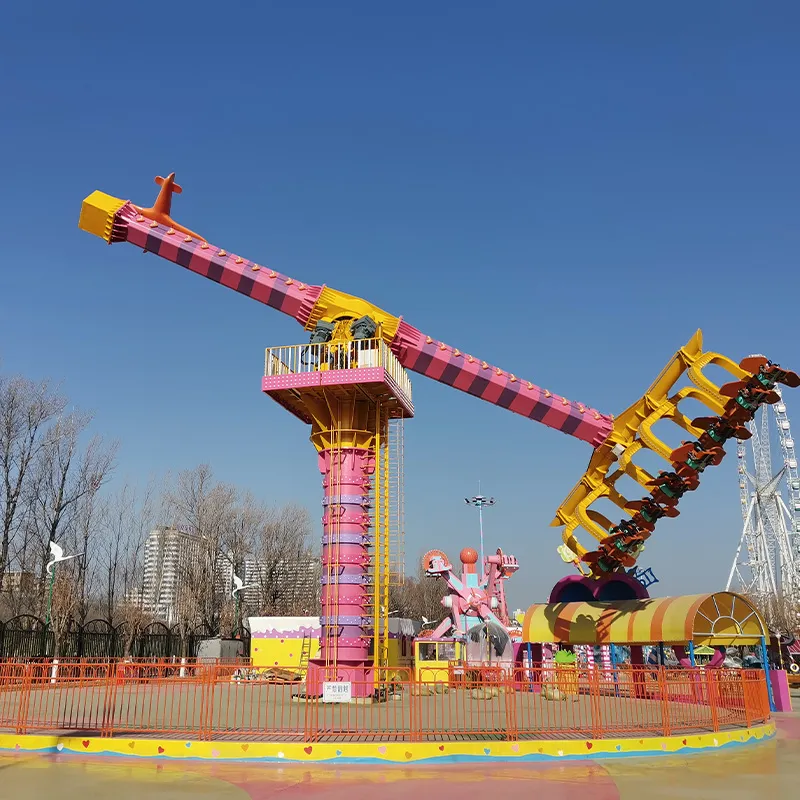
Moon Shake: fast facts and real-world notes
Rotation speed is listed at 4.8 rpm. In practical terms, that’s ≈6.8 m/s tip speed and roughly 0.35 g centripetal acceleration at the main radius; the 50° tilt and gondola dynamics nudge the combined feel closer to ≈1.0–1.1 g depending on profile. Drive power is 150 kW; energy per 270 s cycle lands around 9–12 kWh in factory tests—real-world use may vary with wind, temperature, and operator settings.
| Equipment type | Gyroscope (Other type gyro class), Class A |
| Inclination | 50° |
| Height / Operating height | 20.5 m / 21.2 m |
| Rotation diameter / speed | 27 m / 4.8 rpm (≈0.35 g main rotation) |
| Cabins / Passengers | 12 cabins / 12 passengers total |
| Operation cycle | 270 s (≈160 pph throughput) |
| Drive power / Installed capacity | 150 kW / 189 kVA |
| Power supply | 3N+PE 380V/220V 50Hz |
| Usage / Area | Fixed installation / 780 ㎡ (36 m × 30 m) |
| Design service life | 16 years (under standard O&M) |
| Origin | No.2969 Xiangdu South Road, Xiangdu District, Xingtai City, Hebei Province |
Industry trends (and what operators actually ask for)
- Iconic silhouettes to anchor marketing—Moon Shake’s 27 m arc ticks that box.
- Energy-aware motion profiles; operators want thrilling, not punishing.
- Predictive maintenance: sensor packs for bearings, drives, and PLC logs.
- Nighttime revenue: RGB lighting maps and music sync are now table stakes.
From steel to skyline: process flow at a modern Amusement Equipment Factory
Materials are typically Q345B/S355-grade structural steel; critical shafts use alloy steels heat-treated per design. Methods include CNC cutting, robotic welding (ISO 3834-compliant), and full-surface shot blasting prior to zinc-rich primer and polyester powder coat. Non-destructive testing (UT/MT/VT) is performed by ISO 9712-certified personnel; finite element analysis validates stress hotspots. A typical FAT includes an 8-hour no-load run, functional checks to EN 13814/ASTM F2291, and dynamic load at 1.1–1.25× rated. Electrical integration follows IEC 60204-1; safety PLCs implement dual-channel E-stops. Service life: 16 years, assuming annual inspections, lubrication regime, and periodic NDT per national codes.
Applications and advantages
- Destination parks and resorts needing a signature gyro ride.
- Waterfronts/promenades where skyline presence matters more than capacity.
- Municipal landmarks—sound pressure measured around ≈78 dB(A) near the drive in factory tests, with mitigation options.
Advantages: compact footprint for the visual impact, relatively simple loading flow (12 single-rider cabins), robust drive with conservative thermal margins, and a motion pattern guests remember. Actually, several operators told me the 50° tilt “sells itself” at dusk when the lights kick in.
Customization options
Colorways, LED choreography, soundtrack timing, cabin branding, multilingual HMI, ticketing/paygate interfaces, and wind/temperature adaptive motion profiles. Documentation packs can ship in EN/ES/AR/ZH.
Vendor comparison (snapshot)
| Criteria | Factory in Xingtai | Typical Overseas Vendor |
|---|---|---|
| Standards | EN 13814 / ASTM F2291 / GB 8408 alignment | Varies; often EN/ASTM compliant |
| Customization | High (paint, LED, HMI, motion) | Moderate to high |
| Lead time | ≈5–8 months (spec-dependent) | ≈6–10 months |
| After-sales | Remote + on-site commissioning | Remote; on-site upon request |
| Docs & training | Multi-language O&M, operator training | Varies |
Case notes and feedback
A coastal park install last season reported a double-digit lift in nighttime dwell time after adding synchronized LEDs. Riders mention the “smooth start/stop” and a good “hang-time” feel without head rattle. Maintenance leads liked the accessible laddering and cabinet layout; spares are standard metric, which, I guess, makes everyone’s life easier.
Certifications and references
Design and QA typically reference: EN 13814-1/2/3, ASTM F2291, GB 8408, ISO 9001 for QMS, ISO 13849 for safety control parts, and IEC 60204-1 for electrical. Local AHJ approval will still rule, of course.
References:
[1] EN 13814-1:2019 — Safety of amusement rides
[2] ASTM F2291-23 — Design of Amusement Rides and Devices
[3] GB 8408-2018 — Amusement Device Safety Code
[4] IEC 60204-1:2016 — Safety of machinery: Electrical equipment
-
Ethiopian governmentApr.12,2024
-
On March 20-22Apr.12,2024
-
Comprehensive Guide to Choosing the Perfect sightseeing wheelApr.16,2026
-
Guide to Choosing a Roller Coaster and Ferris Wheel for Your ParkApr.09,2026
-
Find Your Perfect Portable Ferris Wheel for Sale and Elevate EntertainmentApr.07,2026
-
The Captivating World of Portable Ferris Wheels and Event EntertainmentApr.04,2026