
Carnival Wheel Ride – Safe, Colorful, Panoramic Thrills
A Journalist’s Take on the Modern Carnival Wheel Ride: Big Numbers, Real Engineering
If you’ve ever watched a skyline quietly turn into a marketing strategy, you’ve seen what a Carnival Wheel Ride can do. The 103m Ferris Wheel from ZP Roller Coaster has been on my radar for a while—partly because operators keep bringing it up in interviews, partly because it represents where the industry is heading: taller, slower, more comfortable, and (surprisingly) more energy aware.
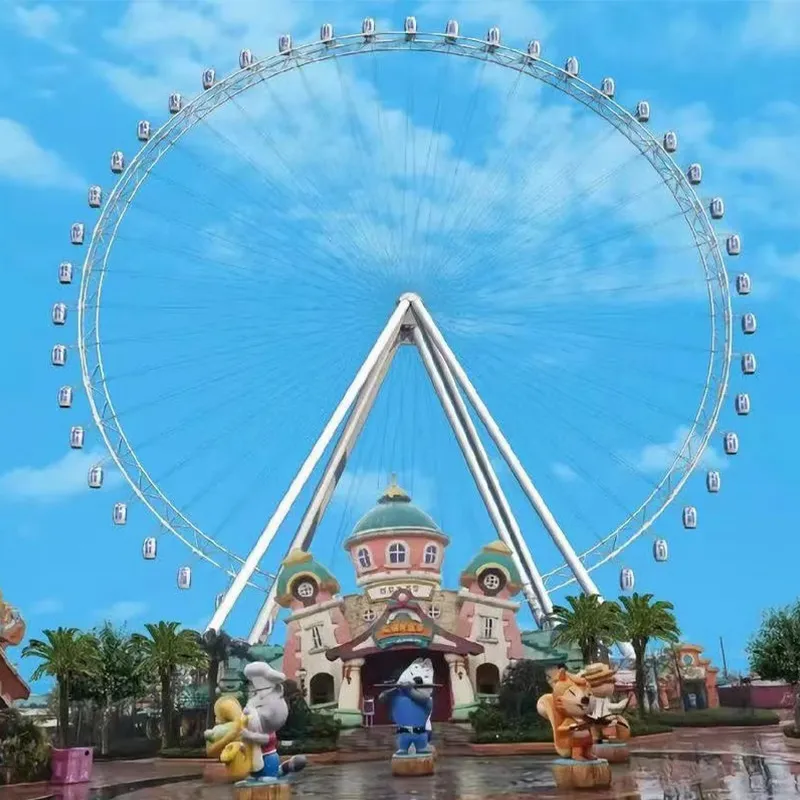
What’s trending (and why it matters)
In fact, observation rides are quietly winning budgets in waterfront redevelopments, mall rooftops, and transit-adjacent plazas. Operators want landmarks that produce both ticket revenue and social media impressions—without the staffing intensity of coasters. A Carnival Wheel Ride ticks those boxes: inclusive experience, long dwell time, beautiful at night with LED packages, and a reputation for reliability when engineered correctly.
Quick look: 103m Ferris Wheel specifications
| Equipment type / Class | Viewing vehicle / Class A |
| Total height | 103 m (rotary Ø ≈ 101 m; runner Ø ≈ 97.7 m) |
| Cabins / Capacity | 48 cabins × 6 persons = 288 riders |
| Speed / Cycle time | ≈0.22 m/s; ≈22 min per revolution (real-world use may vary) |
| Drive / Installed capacity | Drive 48 kW; AC 2.5 kW × 48 = 120 kW; total ≈227 kVA |
| Power supply | 3N+PE 380/220V 50Hz |
| Footprint | Equipment projection 40 m × 103 m; base ≈40 m × 52 m |
| Usage / Design life | Fixed installation; 25 years (design) |
| Origin | No.2969 Xiangdu South Road, Xiangdu District, Xingtai City, Hebei Province |
How it’s built and verified
Structure: high-strength structural steel (typ. Q355-grade or equivalent), shot-blast, hot-dip galvanized (ISO 1461) and top-coated for coastal environments. Key shafts and drive elements use alloy steels with heat treatment, sealed bearings, and redundancy on critical circuits. Cabins are climate-controlled (2.5 kW units), laminated glazing, and optional wheelchair-friendly access cabins.
Methods & testing: 100% visual inspection of welds; UT/MT on critical joints to ISO 17638/17640, weld quality per ISO 5817 (Level C/B as specified). Dynamic load testing to ASTM F2291 design criteria and EN 13814/ISO 17842 structural checks. Factory acceptance often includes a 72‑hour continuous commissioning run; noise at passenger level measured around 60–65 dB(A) under steady operation (site-dependent).
Where it earns its keep
- Tourism districts and waterfront promenades seeking an “instant icon.”
- Retail/entertainment hubs that want a destination anchor with modest staffing.
- City festivals—though this model is fixed, it complements seasonal programming nicely.
Operators I spoke with like the predictable throughput and the “wow” factor at night. Many customers say the ride feels “calm but premium,” which, to be honest, is exactly the point.
Customization options
Colorways to match city branding, programmable LED shows, cabin themes, VIP cabins (sofas, glass floors), onboard audio, multilingual PA, and SCADA dashboards with remote diagnostics. Integration with ticketing/queue systems is common now; it seems that operators want live KPIs on their phones—can’t blame them.
Vendor snapshot (indicative comparison)
| Criteria | ZP 103m Wheel | Vendor A (typ.) | Vendor B (budget) |
|---|---|---|---|
| Design life | 25 yrs | 20–25 yrs | 15–20 yrs |
| Capacity | 48×6 = 288 | ≈240–288 | ≈180–240 |
| Standards alignment | ASTM F2291 / EN 13814 / ISO 17842 (project-specific) | EN 13814 (partial) | Basic local code |
| Installed capacity | ≈227 kVA | ≈230–250 kVA | ≈220–240 kVA |
| After-sales | 24/7 remote + on-site SLA | Business hours | Limited |
Note: Comparative data is indicative; real-world performance depends on site, configuration, and maintenance.
Case note from the field
A coastal install I visited last year reported >98% uptime over peak season, with evening revenues outpacing daytime by almost 2:1—LED shows and sunset timing do heavy lifting. The operator added two VIP cabins mid-season; average ticket yield jumped accordingly. That’s the flexibility you want in a Carnival Wheel Ride.
Safety, documentation, and certification
- Design per ASTM F2291 and EN 13814/ISO 17842, with electrical to IEC 60204-1.
- Third-party structural review and commissioning tests (load, function, emergency egress).
- Maintenance plan: daily checks, weekly torque audits, annual NDT on critical welds.
Paperwork matters. Authorities increasingly want digital maintenance logs and remote diagnostics. This model’s SCADA hooks help—actually make sign-off smoother than it used to be.
Final thought
If your brief reads “landmark, inclusive, reliable,” a modern Carnival Wheel Ride like the 103m checks the right boxes—quietly, and for a long time.
Authoritative citations
- ASTM F2291 – Standard Practice for Design of Amusement Rides and Devices
- EN 13814:2019 – Safety of amusement rides and amusement devices
- ISO 17842 (Parts 1–3) – Safety of amusement rides and amusement devices
- IEC 60204-1 – Safety of machinery—Electrical equipment of machines
- IAAPA – Global guidance and best practices for rides and attractions
-
Ethiopian governmentApr.12,2024
-
On March 20-22Apr.12,2024
-
Comprehensive Guide to Choosing the Perfect sightseeing wheelApr.16,2026
-
Guide to Choosing a Roller Coaster and Ferris Wheel for Your ParkApr.09,2026
-
Find Your Perfect Portable Ferris Wheel for Sale and Elevate EntertainmentApr.07,2026
-
The Captivating World of Portable Ferris Wheels and Event EntertainmentApr.04,2026